
Table of Contents
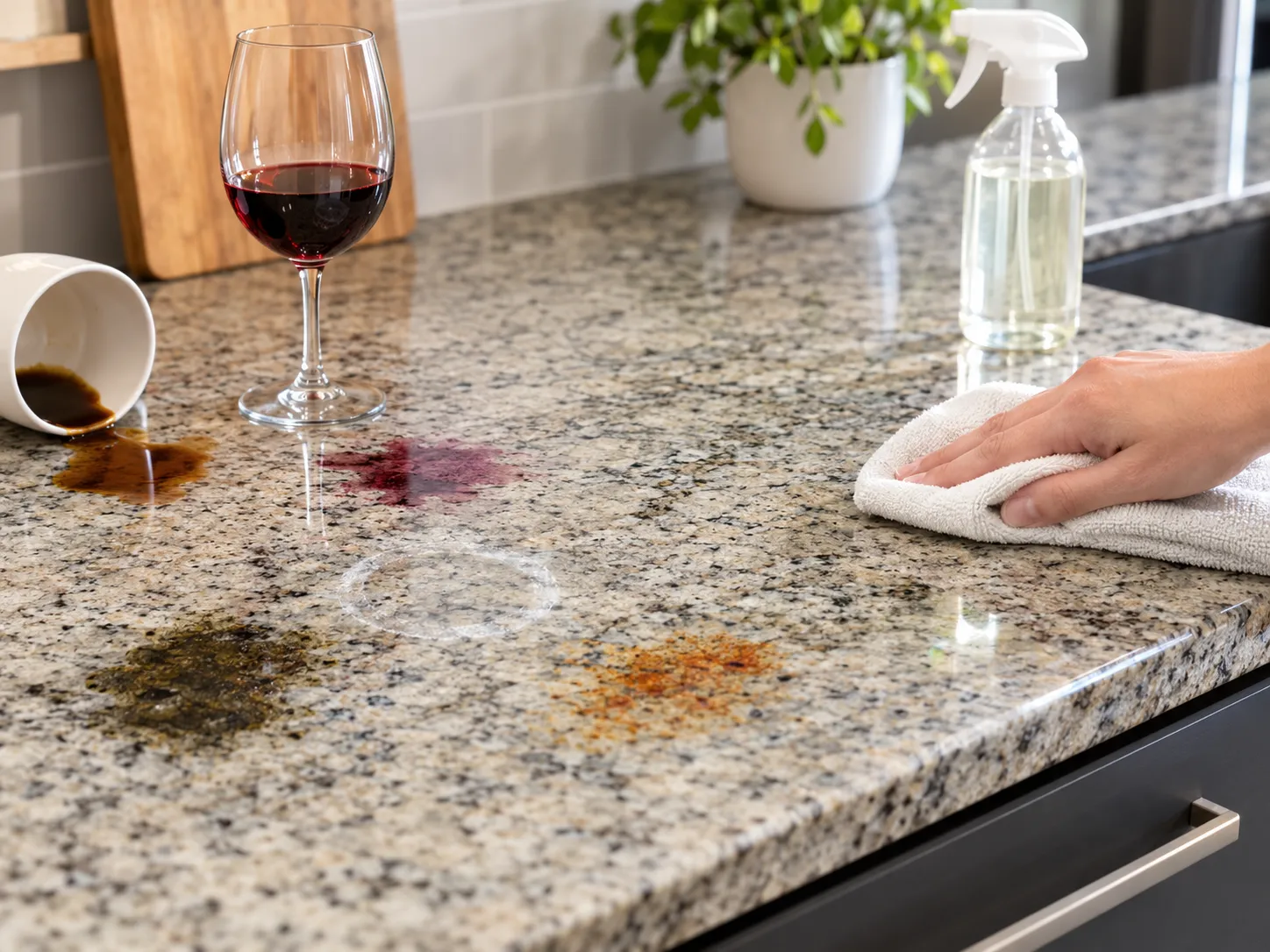
Granite countertops are durable, attractive, and built for everyday use. But even granite can develop dark spots, white marks, discoloration, or stains from cooking oil, coffee, wine, food, rust, water, and other substances.
The important thing is to identify the mark before choosing a cleaning method. An oil stain may need a different treatment from a rust stain, while a white mark around a sink may actually be mineral buildup rather than a stain.
Using the wrong cleaner can make the problem harder to fix or affect the stone’s surface.
In this guide, we explain how to identify common granite stains, what you can try safely, how a poultice works, what to avoid, how to prevent future stains, and when professional stone care may be the better option.
Quick Answer: How Do You Remove a Granite Stain?
The best way to remove a granite stain depends on what caused it.
For a fresh spill, blot it as soon as possible and clean the surface with a product suitable for natural stone.
For a stain that remains after normal cleaning, first identify the type of mark.
| Granite Mark | What It May Look Like | General Treatment |
| Oil or grease | Dark or shadow-like patch | Oil-stain treatment or appropriate poultice |
| Coffee, tea or food | Brown or dark discoloration | Treatment for organic staining |
| Wine or juice | Red, purple, pink or dark mark | Appropriate organic-stain treatment |
| Hard water | White spots, rings or cloudy buildup | Natural-stone-safe mineral deposit cleaner |
| Rust | Orange, reddish-brown or brown mark | Stone-safe rust treatment |
| Ink or dye | Blue, black, purple or colored mark | Treatment appropriate for the stain |
| Unknown dark spot | Dark or shadow-like area | Identify the cause before treating |
| Dull or cloudy area | Change in appearance or finish | May be surface-related rather than a stain |
Do not assume every mark is a stain. Mineral deposits, moisture, residue and surface problems can sometimes look similar.
Before You Remove a Granite Stain
Use this simple process first:
- Identify the mark. Think about what caused it.
- Check the surface. Does the mark change the colour only, or does the surface itself look different?
- Start gently. Blot fresh spills and use an appropriate natural-stone cleaner.
- Avoid random chemicals. Do not keep trying stronger products one after another.
- Stop if the surface changes. Dullness, scratches or a changed finish may indicate a surface problem.
If you are unsure what caused the mark, it is safer to identify the problem before trying an aggressive treatment.
Can Granite Countertops Stain?
Yes. Granite is a durable natural stone, but it is not completely stain-proof.
Some granite surfaces can absorb liquids, especially when the stone is more porous, or the protective treatment has worn down. Oil, wine, coffee, food and other substances can therefore leave discoloration if they remain on the surface.
Sealing can improve resistance to liquid absorption, but it does not mean that spills can be left sitting on the countertop indefinitely.
Rockwood Stone provides professional granite countertop services in Winnipeg in a range of natural patterns and colours, with custom fabrication and installation for homes and businesses.
What Causes Granite to Stain?
Common causes include:
- Cooking oil and grease
- Coffee and tea
- Red wine
- Fruit juice
- Food and sauces
- Ink and dyes
- Rust-producing metal
- Water and mineral deposits
- Other colored substances
The longer a spill remains on the stone, the more opportunity it may have to penetrate a porous area.
What Type of Granite Stain Do You Have?
Before treating the mark, look closely at its colour, location and appearance.
Ask yourself:
- What colour is the mark?
- Is the area darker or lighter than the surrounding granite?
- Does the mark appear to sit on top of the stone?
- Does the surface feel different?
- Is the mark near a sink or faucet?
- Is it close to the stove or food preparation area?
- What was sitting on the countertop before the mark appeared?
These clues can help you choose a suitable treatment.
Oil & Grease
Oil stains often appear as dark patches or shadow-like areas.
They commonly occur near:
- Stovetops
- Cooking areas
- Food preparation areas
- Oily containers
- Areas where greasy items were placed
Oil can penetrate the stone, so simply wiping the surface may not remove the darker appearance.
Coffee, Tea & Food
Coffee, tea, sauces and some foods can leave brown, dark or colored marks.
A fresh spill is usually easier to manage than a stain that has remained on the countertop for a long time.
Wine & Juice
Red wine, fruit juice and other strongly colored liquids can leave red, purple, pink or dark discoloration.
These are generally treated differently from oil or grease.
Hard Water & Mineral Deposits
White or cloudy marks around sinks and faucets may be mineral deposits rather than a stain absorbed into the granite.
They can look like:
- White rings
- White spots
- Gray buildup
- Chalky residue
- Cloudy areas
Do not automatically use vinegar or lemon juice. First determine whether you are dealing with mineral buildup or a change in the stone surface.
Rust & Metal
Rust usually appears orange, reddish-brown or brown.
It can occur beneath or around:
- Metal containers
- Rusting tools
- Metal fixtures
- Other rust-producing objects
Rust requires a different treatment from oil, coffee or food stains.
Ink & Dye
Pens, markers, cosmetics, dyes and other colored products can leave blue, black, purple or other marks.
Because these substances can contain strong pigments, avoid experimenting with random solvents.
Dark or Unknown Marks
A dark mark is not automatically a stain.
It could be:
- Oil
- Moisture
- Food or drink
- Surface residue
- Mineral buildup
- A change in the finish
- Another surface issue
If normal cleaning does not change the appearance, stop before applying increasingly strong chemicals.
How to Remove Common Granite Stains
Once you have identified the likely cause, choose a treatment that matches the stain.
Oil Stains
Oil is one of the more common causes of dark stains on kitchen countertops.
Start by cleaning the area with a product designed for natural stone. Allow the surface to dry completely and check whether the darker area remains.
If the stain has penetrated the stone, an appropriate poultice may help draw the oil out.
A general process is:
- Clean the affected area.
- Allow the granite to dry.
- Choose a poultice or stain treatment appropriate for oil.
- Apply it according to the product instructions.
- Allow it to dry completely.
- Remove the dried material carefully.
- Clean the area as directed.
- Allow the stone to dry before checking the result.
Deep oil stains may require more than one treatment.
The Natural Stone Institute recommends poultice-based treatment for certain oil-based stains and explains that repeated applications can sometimes be needed for difficult stains.
Coffee, Tea & Food Stains
For a fresh coffee, tea or food spill:
- Blot the spill with a clean cloth or paper towel.
- Avoid spreading it over a larger area.
- Clean the surface with a suitable natural-stone cleaner.
- Rinse if the product instructions require it.
- Dry the countertop.
- Check whether discoloration remains.
If the mark remains, it may require treatment for an organic stain.
The important thing is to avoid assuming that a stronger cleaner is automatically the solution.
Wine & Organic Stains
Wine, fruit juice, coffee, tea and some foods can leave colored organic stains.
For a fresh spill:
- Blot the liquid quickly.
- Avoid aggressive rubbing.
- Clean the surface with an appropriate stone-safe cleaner.
- Dry the area.
- Check for remaining discoloration.
If the liquid has penetrated the granite, surface cleaning may not be enough.
A suitable poultice or professional stain treatment may be necessary for a deeper stain. The Natural Stone Institute lists different poultice approaches for organic stains, which reinforces why the treatment should be matched to the stain rather than using one recipe for everything.
Hard Water Deposits
Hard water deposits commonly appear around sinks and faucets.
Before cleaning, determine whether the material is sitting on top of the granite.
If it is mineral buildup, use a cleaner specifically designed for natural stone and follow the manufacturer’s instructions.
Avoid:
- Steel wool
- Metal scrapers
- Rough abrasive pads
- Aggressive scraping
- Unverified acidic cleaners
If the white or cloudy appearance remains after appropriate cleaning, the mark may not be mineral buildup.
Rust Stains
Rust stains usually appear orange, reddish-brown or brown.
First, identify and remove the source of the rust if possible.
If you use a rust-removal product, make sure it is specifically suitable for natural stone and follow the manufacturer’s directions.
Do not assume that a household rust remover is safe for granite.
Rust can be particularly difficult to remove. The Natural Stone Institute notes that iron stains may require a poultice and that difficult rust stains may need professional treatment.
Professional help is especially useful when the rust:
- Covers a large area
- Has penetrated deeply
- Keeps returning
- Does not respond to appropriate treatment
- Has changed the stone’s appearance
Ink & Dye
Ink and dye stains can be difficult because the pigments may penetrate porous stone.
Start by removing any material that is sitting on the surface and use a suitable natural-stone cleaner.
For a deeper stain, the correct treatment depends on the substance involved and the granite surface.
Avoid randomly testing several solvents. A product that removes the ink may also affect the sealer or surface.
If the stain is large or deep, professional evaluation can help determine the safest treatment.
How to Use a Poultice on Granite
A poultice is an absorbent treatment used for certain stains that have penetrated porous stone.
It can be useful for some oil, grease, organic and other stubborn stains.
However, a poultice is not a universal solution for every granite problem.
What Is a Poultice?
A poultice combines an absorbent material with an appropriate treatment for the type of stain.
As the poultice dries, the process can help draw the staining material toward the absorbent material.
The correct poultice depends on:
- The type of stain
- The stone
- The condition of the surface
- The treatment being used
When Should You Use One?
A poultice may be appropriate when:
- Normal surface cleaning has not worked.
- The stain has penetrated the stone.
- The stain is suitable for poultice treatment.
- The selected treatment is appropriate for the stone.
It may be useful for certain oil-based, organic and metal stains.
Do not use one homemade recipe for every type of stain.
General Application Steps
The exact instructions depend on the treatment being used, but a general poultice process includes:
- Clean the stained area.
- Allow the stone to dry.
- Prepare the appropriate poultice.
- Apply it to the affected area as directed.
- Cover the poultice if the treatment instructions require it.
- Allow it to dry thoroughly.
- Remove the dried material carefully.
- Rinse and clean according to the product instructions.
- Allow the area to dry.
- Check the result.
The Natural Stone Institute describes applying poultice at an appropriate thickness, covering it, allowing it to dry thoroughly, and repeating treatment when necessary.
How Long Does a Granite Poultice Take?
There is no single drying time for every poultice.
The time depends on:
- The type of stain
- The treatment
- The size of the affected area
- The stone
- How deeply the stain has penetrated
Many poultice applications require substantial drying time. The Natural Stone Institute describes approximately 24–48 hours as a typical drying period for its general poultice process.
Always follow the instructions for the specific product or treatment you are using.
What If the Poultice Does Not Work?
Do not immediately switch to a stronger chemical.
First ask:
- Was the stain identified correctly?
- Was the treatment appropriate?
- Was the poultice allowed to dry properly?
- Is the mark actually a stain?
- Has the surface itself been affected?
Difficult stains may require repeated treatment or professional stone restoration.
Is It a Stain or Surface Damage?
Not every mark on granite is a stain.
This distinction matters because cleaning will not necessarily fix a problem that has changed the stone’s surface.
Signs of a Stain
A stain generally changes the colour of the stone.
For example, an oil stain may create a darker area while the surface still feels relatively normal.
Possible signs include:
- Dark discoloration
- Brown marks
- Orange marks
- Colored patches
- A shadow-like area
Signs of Surface Damage
A surface problem may look or feel different from the surrounding stone.
You may notice:
- Dullness
- Cloudiness
- Scratches
- Abrasion
- A different surface texture
- A change in the finish
A white or cloudy area can also be residue or mineral buildup, so appearance alone does not always identify the cause.
When Cleaning Isn’t the Answer
If the countertop has a surface or finish problem, repeatedly applying cleaners may not solve it.
Depending on the issue, the stone may need:
- Professional cleaning
- Stain treatment
- Polishing
- Refinishing
- Restoration
- Resealing
- Another specialized repair
If cleaning has already failed, identify the problem before trying another chemical.
What Should You Never Use on Granite?
When removing a stain, stronger does not always mean better.
Avoid Unverified Chemicals
A cleaner designed for another material may not be appropriate for natural stone.
Do not assume that a product made for:
- Glass
- Metal
- Tile
- Concrete
- Bathroom fixtures
is automatically safe for granite.
Choose products specifically intended for natural stone whenever possible.
Be Careful With Vinegar and Other Acids
Vinegar and lemon juice are common household cleaners, but they should not be treated as universal granite stain removers.
If you are dealing with mineral buildup, choose a product specifically designed for natural stone rather than automatically using an acidic household cleaner.
Avoid Abrasive Tools
Do not attack a stain with:
- Steel wool
- Rough abrasive pads
- Metal tools
- Excessive force
- Aggressive scraping
These can scratch or otherwise affect the surface.
Do Not Mix Cleaning Products
Never combine cleaning products because one product did not work.
Different chemicals can react with each other and may create an unsafe mixture or damage the stone.
Test a New Product First
When possible, test a new product on a small, less visible area.
Check for:
- Color changes
- Dullness
- Surface changes
- Finish changes
- Unexpected discoloration
If the surface reacts badly, stop using the product.
How to Prevent Granite Countertop Stains
Preventing stains is usually easier than removing a deep stain later.
Clean Spills Quickly
Blot oil, wine, coffee, juice and food as soon as possible.
Do not allow spills to sit on the countertop unnecessarily.
Use Natural-Stone-Safe Cleaning Products
Choose products made for natural stone or clearly labelled as suitable for granite.
For everyday cleaning, follow the manufacturer’s instructions.
Keep Wet Areas Dry
Pay extra attention to:
- Sinks
- Faucets
- Soap dispensers
- Countertop edges
- Areas around appliances
Regularly removing standing water can help reduce mineral buildup.
Use Coasters and Trivets
Coasters can help protect against drink spills, while trivets can help protect the surface when placing hot cookware on the countertop.
Use cutting boards for food preparation instead of cutting directly on the granite.
Maintain the Sealer
Sealing can improve resistance to liquid absorption, but there is no universal sealing schedule that applies equally to every granite countertop.
The appropriate maintenance depends on the stone, its porosity, usage and existing sealer.
Does Granite Need to Be Sealed?
Many granite countertops benefit from sealing because it can improve resistance to staining and liquid absorption.
However, not every granite surface behaves the same way.
Factors that can affect maintenance include:
- Type of granite
- Porosity
- Finish
- Amount of countertop use
- Previous sealing
- Exposure to liquids
- Condition of the existing sealer
Does Every Granite Countertop Need Sealing at the Same Interval?
No.
Avoid treating a fixed number of months or years as a universal rule.
Instead, consider the particular stone and its use, and follow recommendations appropriate for that countertop.
Rockwood’s current granite information also describes granite as a low-maintenance countertop material and discusses sealing as part of granite care.
Does Sealing Make Granite Stain-Proof?
No.
Sealing improves resistance to absorption, but it does not make granite impossible to stain.
You should still:
- Clean spills quickly.
- Use appropriate cleaners.
- Keep wet areas maintained.
- Avoid harsh chemicals.
If you are comparing granite with other materials for a new project, Rockwood’s stone collection includes granite, quartz, marble, quartzite, porcelain and Dekton options.
When Should You Call a Stone Professional?
Some stains can be handled carefully at home. Others are better evaluated by a professional.
The Stain Has Not Improved
If you correctly identify the stain and use an appropriate treatment without success, avoid repeatedly applying stronger products.
The Stain Covers a Large Area
Large areas can be difficult to treat evenly and may require professional equipment or restoration techniques.
The Surface Has Changed
Consider professional help if the countertop becomes:
- Dull
- Cloudy
- Scratched
- Uneven
- Discoloured after cleaning
The problem may involve the surface rather than a simple stain.
You Do Not Know What Caused the Mark
If you cannot identify the substance, experimenting with several cleaners can make the problem worse.
A stone professional can help determine whether you are dealing with a stain, residue, mineral deposit or surface issue.
The Countertop Is Valuable or Difficult to Replace
If the countertop is expensive, custom-made or part of a larger installation, professional advice can be worthwhile before trying aggressive DIY treatments.
Rockwood Stone provides professional countertop services in Winnipeg, including custom fabrication, installation, old countertop removal, material guidance and finishing services.
Rockwood Stone’s Granite Care Tips
Granite care is not about finding the strongest cleaner.
It is about choosing the right treatment for the right problem.
1. Identify Before You Treat
Oil, rust, coffee, mineral deposits and surface problems can sometimes look similar.
Take a moment to identify the problem before choosing a treatment.
2. Start With the Least Aggressive Method
If you are unsure what caused the mark, begin with gentle cleaning.
Do not immediately use strong chemicals or abrasive tools.
3. Do Not Assume Every Dark Spot Is Dirt
A dark area can be caused by oil, moisture, food, drink or another stone issue.
If normal cleaning does not work, stop and reassess the problem.
4. Follow Product Instructions
If you use a commercial natural-stone cleaner, poultice or stain treatment, follow the manufacturer’s instructions.
Different products are designed for different problems.
5. Protect the Surface Every Day
Simple habits can help:
- Clean spills quickly.
- Use cutting boards.
- Use coasters.
- Use trivets when appropriate.
- Keep wet areas dry.
- Use products made for natural stone.
6. Know When to Stop DIY Cleaning
If an appropriate treatment does not work, applying stronger chemicals repeatedly is not necessarily the answer.
Professional evaluation may be the safer next step.
For homeowners considering a new countertop rather than trying to restore an older surface, Rockwood Stone handles custom stone projects from material selection and measurement through fabrication and installation.
Frequently Asked Questions About Granite Stain Removal
1. Can You Remove a Stain From a Granite Countertop?
Many granite stains can be reduced or removed when the correct treatment is used. The result depends on the type of stain, how deeply it has penetrated, the granite and the condition of the surface.
2. What Is the Best Way to Remove an Oil Stain From Granite?
An appropriate poultice or oil-stain treatment can help with some oil stains by drawing the oil from the stone. Deep or older stains may require professional treatment.
3. How Do You Remove Coffee Stains From Granite?
Blot fresh coffee quickly, then clean the surface with a suitable natural-stone cleaner. If discoloration remains, an appropriate treatment for organic staining may be needed.
4. How Do You Remove Hard Water Stains From Granite?
First, determine whether the mark is mineral buildup or a surface issue. Use a cleaner designed for natural stone and avoid aggressive scraping or unverified acidic cleaners.
5. Can Baking Soda Remove Stains From Granite?
Baking soda can be used as part of some poultice treatments, but it is not a universal solution for every granite stain. The treatment should match the type of stain and the stone.
6. How Do You Remove a Deep Stain From Granite?
Deep stains may require a poultice or another appropriate stone treatment. If the stain remains after proper treatment, a stone professional can evaluate the countertop.
7. Can You Use Hydrogen Peroxide on Granite?
Hydrogen peroxide is used in some stone-stain treatment methods, particularly for certain organic stains, but the appropriate concentration and application depend on the stain and treatment. Do not assume that a household peroxide solution is the correct treatment for every granite surface.
8. Can You Use Vinegar on Granite?
Vinegar should not be treated as a universal granite cleaner. Before using an acidic product, make sure it is appropriate for the specific stone and problem you are treating.
9. How Do You Know if Granite Is Stained or Surface Damaged?
A stain generally changes the colour of the stone while the surface remains relatively normal. Surface problems may cause dullness, scratches, cloudiness or changes in the finish.
10. When Should You Call a Professional?
Consider professional help when the stain is deep, widespread, unknown or does not improve with an appropriate treatment. Professional advice is also useful when the surface becomes dull, scratched, cloudy or otherwise damaged.
Need Help With a Granite Stain in Winnipeg?
Some granite stains can be handled with careful cleaning, but not every countertop problem should become a DIY experiment.
If you have tried an appropriate treatment and the stain remains, or you are not sure what caused the mark, professional advice can help you avoid making the problem worse.
Rockwood Stone specializes in custom stone countertops for residential and commercial customers in Winnipeg and surrounding areas. The company works with granite and other stone materials and provides fabrication and installation services.
If you are dealing with a stubborn granite stain or considering a new countertop, contact Rockwood Stone to discuss your project.
Need help with your countertop? Contact Rockwood Stone for a consultation.
Final Thoughts
Removing a granite stain starts with identifying the problem.
Oil, coffee, wine, hard water, rust, ink and other marks can require different treatments. A method that works for one type of stain may not work for another.
For the best results:
- Clean spills as soon as possible.
- Identify the stain before treating it.
- Use products suitable for natural stone.
- Avoid harsh or unverified chemicals.
- Do not mix cleaning products.
- Avoid aggressive scrubbing and scraping.
- Test new products on a hidden area when possible.
- Do not assume every dark or white mark is a stain.
- Consider professional help when a stain is deep, widespread, unknown or does not improve.
With the right care, granite can remain a durable and attractive countertop surface for many years.
If your countertop needs professional attention or you are planning a new stone countertop in Winnipeg, Rockwood Stone can help with material selection, custom fabrication and installation.