
Table of Contents
A scratch on a kitchen countertop does not always mean the surface needs to be replaced. The right repair depends on what material you have, how serious the damage is, and whether you’re looking at an actual scratch or something that only looks like one.
A light mark on a premium quartz countertop requires a different approach from a scratch in granite, marble, quartzite, or porcelain. Some surfaces can tolerate limited DIY treatment, while others can be permanently damaged by abrasive cleaners, sanding or polishing products.
Before trying toothpaste, baking soda, sandpaper or another household remedy, identify your countertop material and the type of damage.
This guide explains how to tell the difference between a scratch, stain, etching and surface mark, what you can safely try, what to avoid, and when professional countertop repair is the better option.
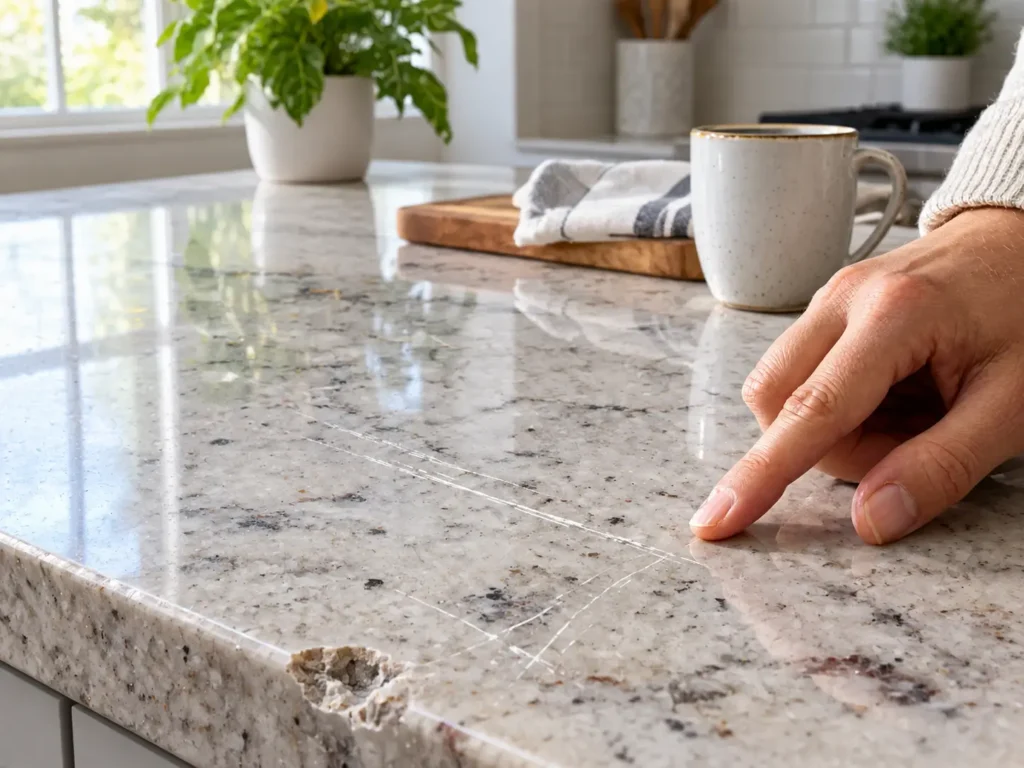
What Is Actually Damaging Your Countertop
Not every mark is a scratch.
Before attempting a repair, run your finger lightly across the affected area and inspect it under good lighting.
Surface residue or metal transfer
Sometimes a pan, appliance or utensil leaves a gray or dark mark on the surface without actually scratching the countertop.
These marks may sit on top of the surface rather than cutting into it.
Cleaning the area with a manufacturer-approved cleaner may be enough.
Stain
A stain changes the appearance of the surface but does not necessarily affect its texture.
Common kitchen sources include:
- Coffee
- Tea
- Cooking oil
- Wine
- Food colouring
- Spices
- Water deposits
Etching
Etching is different from scratching.
It occurs when an acidic substance reacts with a susceptible stone surface and leaves a dull or lighter-looking area. Marble and other calcium-based natural stones are particularly susceptible to etching.
This is especially important with marble. Before trying to remove a mark, it helps to understand the difference between marble stains and etching, since each requires a different approach.
Scratch
A genuine scratch is a physical mark in the surface.
Depending on its depth, it may:
- Feel rough when you run your finger across it
- Catch a fingernail
- Appear as a fine line under direct light
- Become more visible at certain viewing angles
Chip or gouge
If material is actually missing from the countertop, you are dealing with a chip, gouge or deeper damage rather than a simple surface scratch.
That usually requires a different repair approach.
Why Countertop Material Matters
One of the biggest mistakes homeowners make is assuming that every countertop can be repaired using the same method.
They cannot.
A repair technique that may work on one material could leave another surface dull, scratched or permanently damaged.
| Countertop material | Scratch resistance | DIY repair considerations |
| Quartz | High | Avoid aggressive abrasives and sanding |
| Granite | High | Minor surface marks may be treatable, but deeper damage needs assessment |
| Marble | Moderate | Scratches and etching may require honing or polishing |
| Quartzite | High | Repair depends on finish, depth and stone composition |
| Porcelain | High | Surface damage can be difficult to repair invisibly |
| Laminate | Varies | Minor damage may sometimes be repaired with appropriate fillers |
| Solid surface | Varies | Some surfaces can be professionally sanded and refinished |
The safest first step is always to identify the material before choosing a repair method.
How to Fix Light Scratches on a Kitchen Countertop
If the mark is extremely shallow, start with the least aggressive solution.
Step 1: Clean the surface
Remove crumbs, grease and residue using a cleaner approved for your countertop material.
Do not begin sanding or polishing before you know whether the mark is actually a scratch.
Step 2: Inspect the area
Use bright, indirect light.
Look at the countertop from several angles.
A mark that disappears after cleaning may have been surface residue rather than physical damage.
Step 3: Follow the manufacturer’s care recommendations
Different countertop manufacturers can have different recommendations for cleaning and minor repairs.
This is especially important for engineered and porcelain surfaces.
Step 4: Stop if the mark becomes worse
If your cleaning or repair attempt makes the affected area duller or more visible, stop.
Continuing to experiment with increasingly abrasive products can turn a small problem into a larger repair.
How to Fix Scratches on Quartz Countertops
Quartz countertops are designed for everyday kitchen use, but that does not mean they are scratch-proof.
Cutting directly on quartz, dragging hard objects across the surface or using abrasive cleaning pads can still leave visible marks. Our tips for protecting quartz countertops cover these everyday risks and simple ways to avoid unnecessary surface damage..
For minor marks:
- Clean the surface first.
- Confirm that the mark is actually a scratch.
- Follow the quartz manufacturer’s recommended care procedure.
- Avoid abrasive powders, aggressive scrubbing and unapproved sanding.
- Have deeper or visible scratches assessed professionally.
Can you sand a quartz countertop?
Generally, you should not start sanding a quartz countertop as a DIY repair.
The surface finish is part of the appearance of the countertop. Aggressive abrasion can create a dull patch that may be more noticeable than the original scratch.
If the scratch is deep, professional repair may be a safer option.
How to Remove Scratches From Granite Countertops
Granite is a durable natural stone, but the repair method depends on the finish and depth of the scratch. Everyday use can affect granite over time. See our tips for protecting granite countertops.
For a very light surface mark
Start by cleaning the area with a granite-safe product.
Never assume that an abrasive household cleaner is suitable simply because granite is hard.
For a deeper scratch
A deeper scratch may require:
- Polishing
- Professional surface restoration
- Filling
- Colour matching
- Refinishing
The surrounding finish also matters.
A repair that changes the polish level can create a visible patch even if the scratch itself disappears.
How to Repair Scratches on Marble Countertops
Marble requires extra care because it is more susceptible to scratching and chemical etching than many engineered countertop materials.
First, determine whether you are dealing with:
Scratch → physical surface damage
or
Etching → chemical reaction that leaves a dull area
These problems require different treatments.
For shallow marble damage, professional honing or polishing may restore the surface. Deep scratches may require more extensive restoration.
Avoid experimenting with aggressive sanding or acidic cleaning products.
What About Scratches on Quartzite Countertops?
Quartzite is a natural stone, but its care requirements are not identical to quartz.
If your quartzite countertop develops a visible scratch:
- Clean the surface.
- Check whether the mark is residue or actual damage.
- Determine whether the surface is polished, honed or another finish.
- Avoid untested abrasive products.
- Have deeper scratches professionally assessed.
Quartzite can be extremely hard, but hardness does not mean every countertop repair method is safe.
Can Scratches Be Repaired on Porcelain Countertops?
Porcelain countertops are highly durable and resistant to many forms of everyday wear, but repairing visible surface damage can be more complicated than repairing some natural stone surfaces.
Small marks should first be evaluated to determine whether they are:
- Surface residue
- Metal transfer
- Actual scratching
- Chipping
- Edge damage
Avoid using sandpaper or aggressive abrasives without knowing how they will affect the surface finish.
If the porcelain itself has been damaged, professional assessment is usually preferable to experimenting with household repair methods.
Should You Use Toothpaste to Remove Scratches?
This is one of the common DIY suggestions found online.
But a household remedy should not automatically be considered safe for every countertop material.
Toothpaste contains mild abrasives, and abrasive action can alter the finish of a countertop.
The bigger problem is that the same recommendation gets repeated for:
- Quartz
- Granite
- Marble
- Quartzite
- Porcelain
These surfaces do not all respond the same way.
Rather than choosing a DIY remedy first, identify the countertop material first.
Should You Use Baking Soda on a Scratched Countertop?
Baking soda is another commonly suggested household solution.
But baking soda is mildly abrasive.
That means it may not be appropriate for every finish.
If your countertop manufacturer does not recommend abrasive cleaning products, don’t use baking soda as a scratch-removal experiment.
A small scratch is usually easier to deal with than a larger dull patch created by aggressive rubbing.
Can You Sand a Scratched Countertop?
This is one of the most important questions to answer clearly.
Do not automatically sand the countertop
Sanding changes the surface itself.
Whether it is appropriate depends on:
- Material
- Finish
- Scratch depth
- Location
- Surrounding surface
- Required finish after repair
A homeowner may remove a scratch but create an obvious matte or dull spot around it.
Professional restoration equipment and techniques can produce a more consistent result when surface refinishing is appropriate.
When Is a Countertop Scratch Too Deep to Fix Yourself?
Consider professional repair when:
- Your fingernail catches significantly in the scratch
- The scratch is long or highly visible
- The stone has chipped
- Material is missing
- The damage reaches an edge
- The surface finish has changed
- The countertop has multiple scratches
- You are unsure what material you have
- A previous DIY repair made the area worse
A professional can determine whether the surface can be repaired, refinished or whether replacement is more practical.
Scratch vs Chip vs Crack: Know the Difference
These terms are often used interchangeably, but they describe different problems.
| Damage | What it means | Typical response |
| Scratch | Surface line or abrasion | Cleaning, polishing or repair depending on material |
| Chip | Piece of material missing | Filling/repair |
| Crack | Fracture through the material | Professional assessment |
| Etching | Chemical surface damage | Honing/polishing depending on material |
| Stain | Discolouration | Material-specific cleaning |
| Dull spot | Loss of surface sheen | Finish restoration |
Correctly identifying the damage prevents you from using the wrong repair method.
What Not to Do When Repairing a Scratched Countertop
Avoid these common mistakes:
Don’t use random abrasive cleaners
A product that works on a sink may damage a countertop finish.
Don’t sand before identifying the material
The wrong sanding method can make the damage more visible.
Don’t assume all stone is the same
Quartz, granite, marble and quartzite have different characteristics.
Don’t use acidic cleaners on susceptible natural stone
Acid can cause etching on materials such as marble.
Don’t keep rubbing if the surface becomes dull
Stop and reassess the damage.
Don’t ignore deep chips and cracks
These may require professional attention rather than cosmetic cleaning.
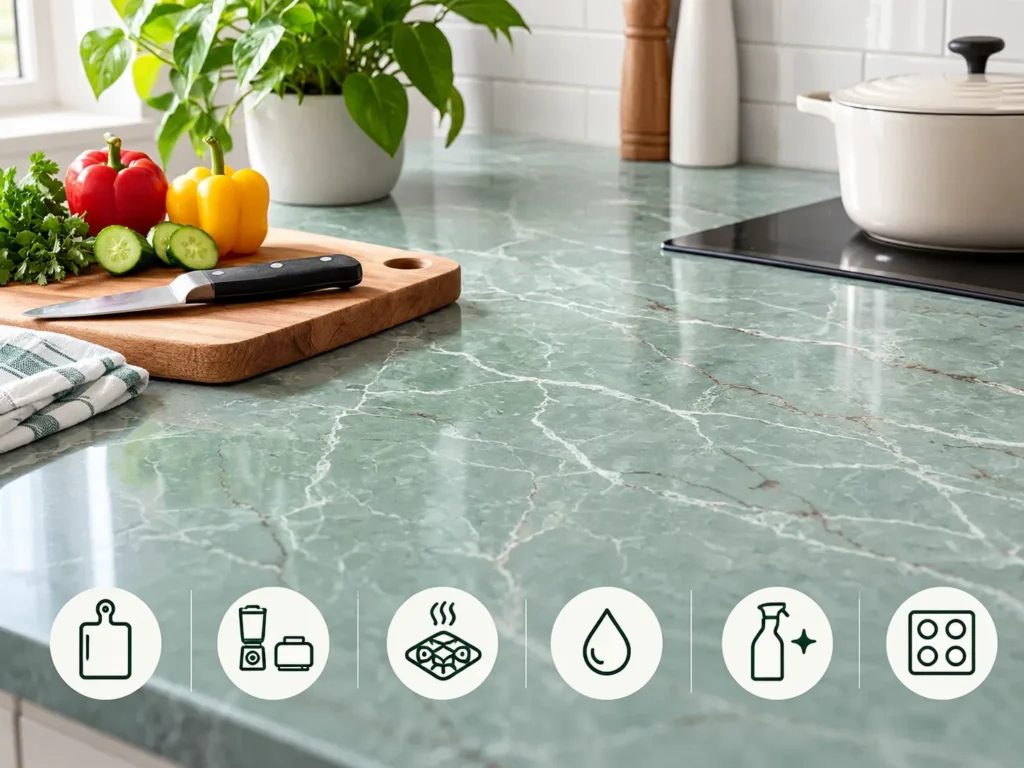
How to Prevent Scratches on Kitchen Countertops
Prevention is much easier than repair.
Use cutting boards
Never use the countertop as a cutting surface unless the material and manufacturer specifically permit it.
Lift appliances instead of dragging them
Small appliances can leave marks when repeatedly moved across the surface.
Use appropriate trivets and protective pads
Heat and impact protection can help reduce surface damage.
Clean spills promptly
This is especially important for natural stones that may be affected by certain substances.
Use material-appropriate cleaners
Avoid assuming that a universal cleaner is safe for every countertop.
Pay attention to high-use areas
The areas around:
- sinks
- cooktops
- islands
- prep stations
- appliance zones
often receive the most daily wear.
When Should You Replace Instead of Repairing a Countertop?
Repair isn’t always the best long-term solution.
Replacement may make more sense when:
- Damage is extensive
- There are multiple deep scratches
- The countertop has significant cracking
- The surface finish is badly compromised
- The countertop is already near the end of its useful life
- The existing material no longer suits the kitchen
- A repair would remain highly visible
If you’re already considering replacement, compare materials based on daily use, maintenance, appearance, heat exposure, moisture and expected wear, rather than choosing solely by scratch resistance.
Frequently Asked Questions
Can a scratched quartz countertop be repaired?
Some scratches can be professionally repaired, depending on their depth and location. Avoid aggressive DIY sanding because it can alter the finish.
Can you remove scratches from granite?
Minor surface marks may sometimes be treated, while deeper scratches may require professional polishing or repair.
Can marble scratches be polished out?
Some surface scratches can be addressed through honing or polishing, but the correct method depends on the depth and finish.
Is quartz scratch-proof?
No. Quartz is highly resistant to everyday scratching, but it is not completely scratch-proof.
Is quartzite scratch-proof?
No countertop should be considered completely scratch-proof. Quartzite is hard and durable, but surface damage can still occur.
Can baking soda remove countertop scratches?
Baking soda is mildly abrasive, so it should not be used indiscriminately. Always follow the care recommendations for the specific countertop material.
Can toothpaste remove scratches from countertops?
Toothpaste contains abrasives and may affect the finish. It should not be treated as a universal countertop scratch-removal solution.
Can I sand my countertop?
Not as a general DIY recommendation. Sanding can change the surface finish and may create a larger visible repair area.
When should I call a countertop professional?
Call a professional when the scratch is deep, catches your fingernail, reaches an edge, involves a chip or crack, or when you’re unsure which repair method is safe.
Conclusion
A scratched kitchen countertop does not automatically mean the countertop needs to be replaced. The right solution starts with identifying the material and type of damage.
A light surface mark may only require proper cleaning, while a genuine scratch, chip, etch or crack may need a different treatment. Quartz, granite, marble, quartzite and porcelain should not all be treated with the same DIY repair method.
When you’re unsure, avoid aggressive sanding, abrasive cleaners and untested household remedies. A professional assessment can help determine whether the countertop can be repaired, refinished or should be replaced.
For Winnipeg homeowners choosing a new surface, Rockwood Stone Countertops offers quartz, granite, marble, quartzite, porcelain and Dekton countertops, with fabrication and installation services for residential and commercial projects.