
Table of Contents
When it comes to marble countertops, both bathroom and kitchen countertops offer a clean and elegant surface that adds beauty and value to a home, but they also differ in how they support daily use, design needs, and care routines. Marble bathroom countertops bring a clean as well as calm feel to the space, working well with water, steam and everyday grooming while keeping a smooth and elegant look.
On the other hand, marble kitchen countertops add a strong and rich design element to cooking spaces, handling food prep, heat, oil, and spills while still maintaining their natural charm when cared for properly.
Since premium marble countertops in Winnipeg perform differently in bathroom and kitchen environments, understanding these differences is important. Knowing how each surface behaves in real use can help you choose the right application for marble in your home and select a surface that fits both your style and daily requirements.
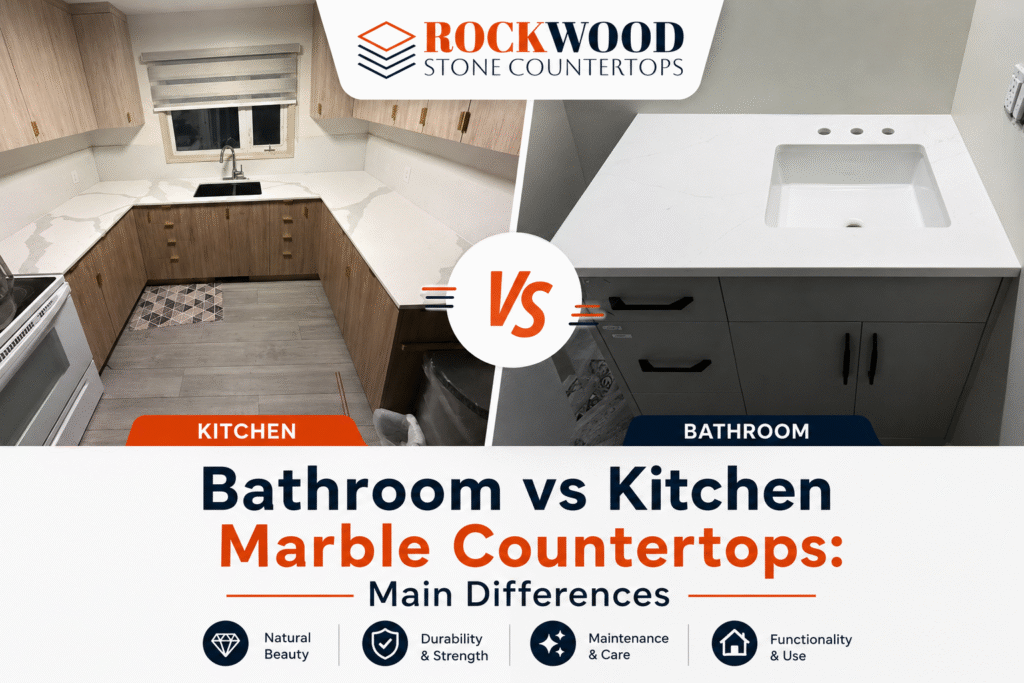
Difference Between Bathroom and Kitchen Marble Countertops
While marble countertops for the kitchen and bathroom may look similar at first, they perform differently based on how each space is used every day. Both are made from natural stone and offer a clean, smooth finish. Still, the way they handle water, heat, stains, and daily wear can affect how well you are able to maintain the marble countertop’s shine over time.
When choosing marble for your home, it is easy to focus only on appearance. While that is important, the real difference lies in how each surface reacts to daily life. Bathrooms have steady moisture and light use. Kitchens face heavy cooking activity, spills and frequent contact with food.
Due to the fact that both spaces use marble for different needs, understanding these differences helps you avoid problems later. It also helps you choose the right level of care and placement for long-term use.
Here are some of the key differences between bathroom and kitchen marble countertops.
Daily Use and Pressure
When compared to bathroom marble countertops, kitchen marble countertops perform well in a high-use environment, especially when properly sealed and maintained. They maintain their appearance and function in areas exposed to food prep, heat, oil, and spills, but they require more frequent care to keep their finish consistent.
Bathroom marble countertops perform very well in low-moisture, light-use conditions. They maintain a smooth and clean look in spaces with water, steam, and basic grooming.
Water Exposure
While both bathroom and kitchen marble countertops perform well under daily exposure to water, bathroom marble countertops maintain a more stable and consistent finish when exposed to water and steam. Their performance remains steady because moisture exposure is more uniform and easier to control with proper sealing.
Kitchen marble countertops also perform well with water exposure, but their performance can be influenced by overall kitchen activity, where water is not the only element involved during daily use.
Overall, bathroom marble countertops show more consistent performance under water exposure, while kitchen marble countertops need more active care to maintain their appearance.
Heat Handling
Bathroom marble countertops maintain a stable surface in low heat conditions and do not show changes in appearance or performance under normal bathroom use.
Kitchen marble countertops are generally heat-resistant to a point, but placing hot cookware directly on them may reduce long-term surface quality.
Overall, bathroom marble countertops stay unaffected under low heat conditions, while kitchen marble countertops require more controlled use to maintain their surface quality under heat.
Cleaning and Maintenance Needs
In terms of cleaning and maintenance needs, bathroom marble countertops require simpler and less frequent maintenance. Their surface stays consistent with light daily cleaning, helping them retain a fresh as well as polished look with minimal effort.
Kitchen marble countertops need more frequent and timely maintenance to preserve their appearance. Regular attention after use helps them stay clean and maintain their finish over time.
With that said, both bathroom and kitchen marble countertops do not require heavy maintenance and can perform well with regular basic care suited to their use.
Stain and Damage Risk
Bathroom marble countertops show better resistance to everyday staining, as their use involves fewer strong substances and lighter surface contact.
Kitchen marble countertops are more exposed to staining factors, which means their surface needs more frequent attention to maintain the same clean finish. They can still perform well, but require quicker cleaning to avoid long-term marks as well as surface dullness.
Understanding marble countertop stains and etching is important when comparing how both surfaces maintain their appearance over time.
Overall, bathroom marble countertops maintain a more stable appearance with lower stain and damage risk when compared to kitchen marble countertops.
Conclusion
Even though both bathroom and kitchen marble countertops bring natural beauty and a clean finish to a home, they serve different needs based on daily use. Bathrooms offer a low-stress environment where marble stays in good shape with simple care. Kitchens bring heavy use, which means more attention is needed to keep the surface clean and protected.
When choosing between the two, it comes down to how the space is used every day. Bathrooms are easier on marble, while kitchens demand more care but offer a strong visual impact.
Are you looking for marble countertops for your kitchen or bathroom? Rockwood Stone offers a wide range of marble countertops for both kitchens and bathrooms that are designed to balance style, durability, and everyday performance, helping you create spaces that look refined and work well for daily use.
Frequently Asked Questions
Do marble countertops stain more in kitchens or bathrooms?
Marble stains more in kitchens because it comes in contact with food, oil and acidic ingredients more often than in bathrooms.
Why do bathroom and kitchen marble countertops require different care approaches?
Different environments expose marble to different elements. Bathrooms involve moisture, while kitchens involve food as well as heat, which leads to different care needs.
Does sealing affect a marble countertop’s performance in bathrooms and kitchens?
Yes, sealing helps protect marble countertops by reducing absorption and makes them easier to maintain in both bathrooms and kitchens.
Can marble work well in both bathrooms and kitchens?
Yes, marble works in both spaces when properly sealed and cared for, but each area requires a different level of maintenance.
Does marble behave differently in wet areas compared to cooking areas?
Yes, marble reacts differently. Wet areas like bathrooms mainly involve water and steam, while cooking areas involve heat, oil and food exposure, which place different demands on the surface.