
Table of Contents
White marble countertops can make a kitchen feel brighter, but choosing the right design involves more than selecting a white slab. Cabinet colours, veining, backsplash materials, lighting, and countertop finishes all affect how the finished kitchen looks.
Some homeowners prefer a clean, all-white kitchen, while others combine white marble with warm wood, dark cabinetry, or contrasting colours. The right combination depends on the kitchen’s layout, natural light, and the amount of maintenance you are comfortable with.
For homeowners comparing white marble countertop ideas, this guide covers seven kitchen designs, how to choose a suitable marble slab, and what to consider before installation.
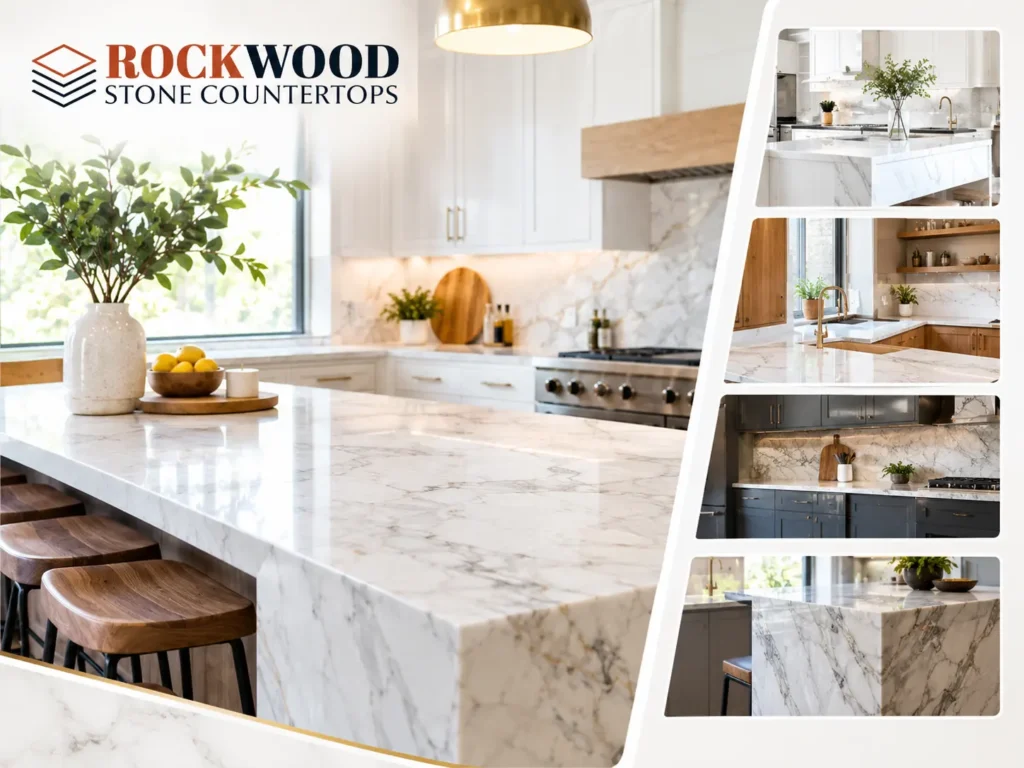
1. White Marble Countertops With White Kitchen Cabinets
An all-white kitchen creates a consistent, light appearance. White marble countertops add natural veining that helps separate the work surface visually from white cabinets.
The key is choosing the right combination of whites. Some marble slabs have cool grey veins, while others contain warmer beige or gold tones. These details can influence whether the countertop works well with the cabinet colour.
Design tips:
- Pair cool white cabinets with marble that has soft grey veining.
- Consider warmer white cabinetry with marble featuring beige or gold accents.
- Add texture through cabinet handles, lighting, or a subtle backsplash.
- Use under-cabinet lighting to make the marble’s natural pattern more visible.
White cabinets and white marble countertops work particularly well when you want the kitchen to feel open without relying on bold colours.
2. White Marble Countertops With Natural Wood Cabinets
Wood cabinetry introduces warmth into a kitchen dominated by white surfaces. The contrast can make the marble feel less formal while allowing its natural veining to remain visible.
Light oak and maple cabinets suit kitchens with a soft, natural colour palette. Walnut and darker wood tones create a stronger contrast against white marble.
How to coordinate the materials:
- Choose light wood for a Scandinavian-inspired kitchen.
- Use walnut cabinets when you want deeper tones and more contrast.
- Keep the backsplash simple if the marble has prominent veining.
- Match the wood’s undertone with the overall colour palette rather than trying to match every surface exactly.
This combination is worth considering if you like white marble but want to avoid an entirely white kitchen.
3. White Marble Countertops With Grey Cabinets
Grey cabinets provide contrast without introducing the strong colour difference created by black or very dark cabinetry. They also work with many white marble slabs that feature grey veins.
Light grey cabinets create a softer transition between the countertop and cabinetry. Charcoal grey cabinets produce a more dramatic look, especially when paired with a bright white marble surface.
Before selecting a slab, compare its veining with the cabinet sample under the kitchen’s actual lighting. A marble pattern that appears subtle in a showroom may look more pronounced across a large countertop.
Design tips:
- Combine light grey cabinets with white marble featuring fine grey veins.
- Use charcoal cabinets for a stronger contrast.
- Consider brushed metal or matte black hardware.
- Keep other patterned surfaces restrained when the marble has bold movement.
4. White Marble Countertops With a Waterfall Kitchen Island
A waterfall island extends the countertop material down one or both sides of the island to the floor. With white marble, this design makes the stone’s veining a central feature of the kitchen.
The result depends heavily on the individual slab. Some marble has subtle, fine lines, while other varieties contain broad, dramatic veins. A waterfall edge can make these patterns more prominent because the stone becomes visible across several surfaces.
Before fabrication, discuss vein direction, edge details, and how the pattern will meet at the corners.
What to consider:
- Select a slab with a pattern that suits the island’s size.
- Plan the vein layout before cutting begins.
- Consider how seams and adjoining pieces will appear.
- Confirm the edge profile and any additional fabrication costs.
Marble waterfall islands are often best suited to kitchens where the island has enough space to serve as a focal point.
5. White Marble Countertops With a Contrasting Backsplash
A backsplash can either complement the marble or introduce a different texture. The right choice depends on the amount of movement in the countertop’s natural pattern.
For example, white marble with prominent grey veins can work with a simple white backsplash. Marble with a quieter pattern may allow more variation in the backsplash material.
Popular combinations include:
- White marble with white subway tiles for a simple, traditional look.
- White marble with light grey tiles for a coordinated colour scheme.
- White marble with a restrained dark backsplash for contrast.
- Matching marble countertops and backsplash for a continuous stone appearance.
Using the same marble on the countertop and backsplash can create visual continuity, but the slab pattern should be planned carefully. Too many competing patterns may make a small kitchen feel visually busy.
For a more cohesive result, choose the countertop first and compare backsplash samples against the actual slab.
6. Honed vs. Polished White Marble Countertops
The finish changes how white marble looks and behaves in everyday use.
A polished finish has a glossy surface that reflects light and makes the stone’s colours and veins appear more pronounced. A honed finish has a matte or low-sheen appearance that creates a softer effect.
Neither finish makes marble maintenance-free.
| Feature | Polished marble | Honed marble |
| Appearance | Glossy and reflective | Matte or softly reflective |
| Veining | Often appears more pronounced | Often appears more subdued |
| Surface marks | Etching may be noticeable in the shine | Etching may be less visually obvious |
| Everyday care | Requires prompt spill cleanup | Also requires prompt spill cleanup |
| Best suited to | Glossy, light-reflecting designs | Softer, understated designs |
Marble is susceptible to etching from acidic substances such as lemon juice, vinegar, and some cleaning products. Honed marble can also show stains and other marks, so a matte finish should not be treated as protection against damage.
Finish affects the appearance of marble, but acidic spills can still etch the surface; understanding marble stains and etching can help you decide how much upkeep suits your kitchen.
7. White Marble Countertops With Dark Cabinets
Dark cabinetry creates a strong contrast with white marble. Black, navy, and deep charcoal cabinets can make a white countertop stand out, especially when the slab has distinctive veining.
This combination works well when you want the countertop to be a prominent feature rather than a background surface.
Ways to balance the contrast:
- Use white marble with grey veins for a coordinated black-and-white palette.
- Choose softer lighting to avoid harsh contrasts.
- Add warm wood accents to reduce the starkness of the colour scheme.
- Keep the cabinet hardware and backsplash consistent with the overall design.
In smaller kitchens, consider using dark colours on the island or lower cabinets while keeping upper cabinets lighter. This can introduce contrast without making every part of the room feel heavy.
Which White Marble Is Right for Your Kitchen?
White marble is available in a range of patterns, from subtle grey veining to bold, flowing designs. The best option depends on the look you want and how the kitchen will be used.
When comparing slabs, consider the following:
Veining and colour: Carrara marble often features a softer white-to-grey appearance with fine or moderate grey veining. Calacatta marble is commonly associated with a brighter white background and more pronounced veins, although natural variation exists within both groups.
Slab consistency: Natural stone varies from slab to slab. Review the actual slab rather than relying exclusively on a small sample or product photograph.
Kitchen layout: A large island may benefit from a slab with a pattern that can be positioned deliberately. Smaller work areas may suit a quieter pattern.
Maintenance expectations: Marble is a natural stone that can etch when exposed to acids and can stain if spills are not managed appropriately. Ask about suitable sealing products and the recommended maintenance routine for your selected stone.
Overall cost: The final price depends on the selected slab, countertop dimensions, cutouts, edge profiles, fabrication, and installation. Request a project-specific estimate instead of comparing material prices alone.
Are White Marble Countertops Practical for Everyday Kitchens?
White marble can be used in everyday kitchens, but it requires realistic expectations about maintenance.
Marble is a calcium-carbonate-based natural stone and can react with acidic substances. Lemon juice, vinegar, wine, and acidic cleaners may etch the surface. Oils and other substances can also stain marble under certain conditions.
To care for a marble countertop:
- Clean spills promptly, especially acidic liquids and cooking oils.
- Use a cleaner approved for natural marble.
- Avoid abrasive products and acidic household cleaners.
- Use cutting boards and trivets to protect the surface.
- Ask your stone supplier whether sealing is recommended and how often it should be repeated.
Sealing can help reduce the absorption of certain liquids, but it does not prevent acid etching or make marble stain-proof. If low maintenance is your main priority, compare marble with other countertop materials before choosing.
White Marble vs. Quartz Countertops
White marble and white quartz can create similar colour schemes, but they differ in composition and maintenance.
Marble is a natural stone with individual veining patterns. Quartz countertops are generally engineered surfaces made with quartz and other materials, bound with resins and pigments.
| Feature | White marble | White engineered quartz |
| Pattern | Natural variation | Manufactured patterns with more controlled consistency |
| Acid resistance | Susceptible to etching | Generally more resistant to everyday acids, depending on the product |
| Stain resistance | Depends on stone, finish, sealing, and care | Generally low absorption, but product-specific limitations apply |
| Heat care | Avoid sudden thermal changes and direct contact with hot cookware | Protect from direct heat and follow manufacturer instructions |
| Maintenance | Requires attention to spills and stone care | Usually simpler routine care |
Neither material should be treated as indestructible. Product specifications and care instructions vary, so compare the particular slabs and product warranties before deciding.
If easy daily care is a priority, comparing quartz and porcelain countertop materials can help you assess alternatives to natural marble.
How to Choose the Right White Marble Countertop
Before placing an order, take time to review the details that affect both appearance and daily use.
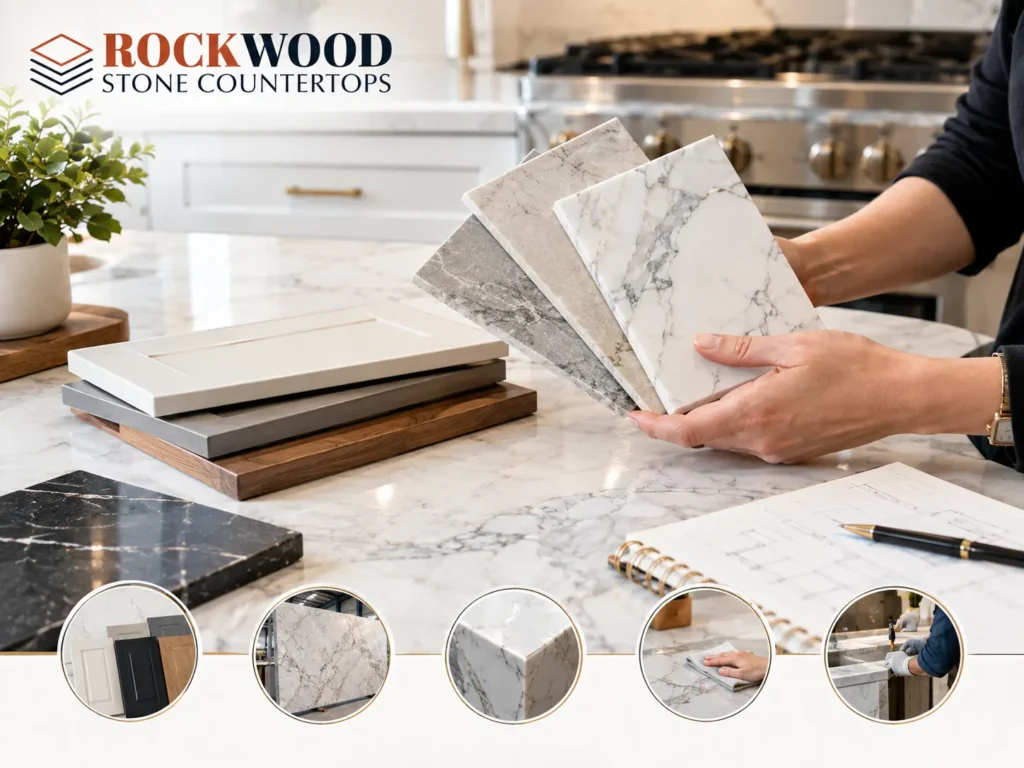
- Bring cabinet and backsplash samples. Compare them directly against the stone rather than relying on screen colours.
- View the actual slab. Natural patterns can vary considerably, even within the same marble variety.
- Plan seams and edges. Ask how the slab will be cut, where seams may fall, and how the veining will align.
- Discuss maintenance. Confirm appropriate cleaners, sealing recommendations, and the limitations of marble.
- Confirm the full installation cost. Include cutouts, edge profiles, fabrication, delivery, and installation in the estimate.
These steps help you evaluate the complete countertop project rather than selecting a material based on appearance alone.
Explore White Marble Countertops at Rockwood Stone Countertops
At Rockwood Stone Countertops, we help homeowners compare stone options for kitchen countertops and other interior surfaces. Our process includes slab selection, measurements, custom fabrication, and professional installation.
If you are planning a kitchen renovation, compare marble colours and veining with your cabinetry, backsplash, and lighting before settling on a design. Seeing the actual stone can help you make a more informed decision about the final appearance.
Frequently Asked Questions
1. Are white marble countertops suitable for everyday kitchens?
Yes, white marble countertops can be used in everyday kitchens, but they require careful maintenance. Marble can etch when exposed to acidic foods and cleaners, and certain spills may stain the surface. Prompt cleaning, suitable stone cleaners, and appropriate sealing can help maintain its appearance.
2. What colour cabinets look best with white marble countertops?
White, light grey, charcoal, navy, and natural wood cabinets can all work with white marble countertops. White cabinets create a consistent, bright appearance, while darker cabinets provide contrast. The best combination depends on the marble’s veining, the kitchen’s lighting, and the overall colour scheme.
3. Do white marble countertops stain easily?
White marble can absorb certain liquids and develop stains, particularly when spills are left on the surface. Its susceptibility depends on the stone, finish, and exposure to different substances. Clean spills promptly and ask your stone supplier about the appropriate sealer and maintenance routine.
4. Is honed or polished white marble better for a kitchen?
Polished marble has a glossy finish that reflects light and often makes veining more pronounced. Honed marble has a matte appearance that creates a softer look. Both finishes can etch and stain, so your decision should depend on your preferred appearance and willingness to maintain the surface.
5. How do you clean white marble kitchen countertops?
Clean white marble with a soft cloth and a pH-neutral cleaner approved for natural stone. Avoid vinegar, lemon juice, abrasive powders, and acidic household cleaners. Wipe spills promptly, and follow the fabricator’s recommendations for sealing and routine care.
6. Are white marble countertops more expensive than quartz?
The cost depends on the specific slab, material quality, countertop dimensions, edge profiles, cutouts, fabrication, and installation. Some marble options may cost more than certain quartz products, but prices vary. Request comparable estimates for the actual materials and work required for your kitchen.
Conclusion
White marble countertops can suit a variety of kitchen styles, from all-white cabinetry and natural wood finishes to grey cabinets and dark, contrasting designs. The most successful combination depends on the marble’s veining, the surrounding materials, and how you use your kitchen.
Compare actual slabs, review the available finishes, and understand the maintenance requirements before choosing. With careful material selection and fabrication planning, you can create a kitchen design that works for your space and your everyday needs.