
Table of Contents
When choosing a kitchen countertop, appearance is only part of the decision. The surface also needs to handle hot cookware, food spills, knives, daily cleaning, moisture and years of regular use.
That is where Dekton kitchen countertops stand out. Dekton is an ultra-compact surface designed for demanding applications, with strong resistance to heat, stains, scratches, UV exposure and everyday wear. Its low porosity also makes routine cleaning relatively simple.
But no countertop should be chosen based on one feature alone. The thickness, edge design, installation, finish and way the surface is used all matter.
This guide explains how Dekton performs in real kitchen conditions, what it can handle, where you still need to use care, and when it may be a practical choice for a Winnipeg kitchen.
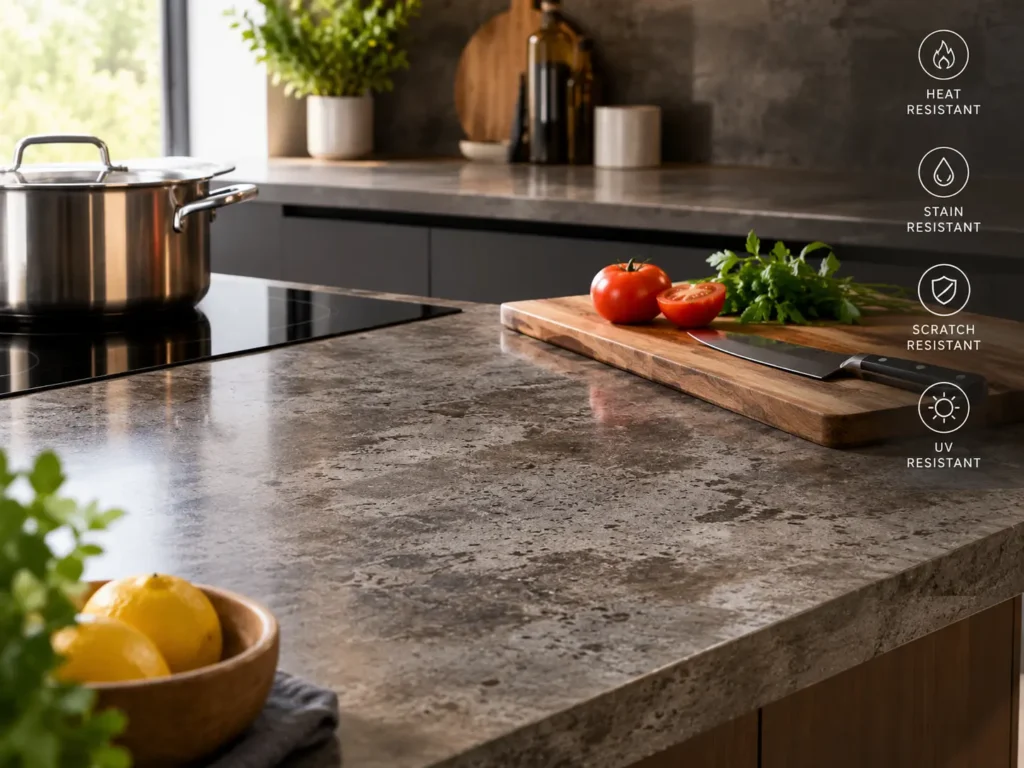
Is Dekton Good for Kitchen Countertops?
Yes. Dekton is designed specifically for demanding applications, including kitchen worktops.
Its main performance advantages include:
- High resistance to heat
- High resistance to stains
- High scratch resistance
- Low water absorption
- UV resistance
- Resistance to everyday wear
- Low-maintenance cleaning
- Indoor and outdoor applications
The manufacturer of Dekton describes the material as resistant to heat, scratches, stains, UV rays and everyday wear.
For a busy kitchen, that combination matters because the countertop is exposed to many different types of use throughout the day.
You may prepare food on one section, place cookware near the cooking area, clean spills from another section and use the island for meals, homework or entertaining.
A countertop needs to perform across all of those situations rather than simply look good when it is first installed.
How Heat Resistant Are Dekton Kitchen Countertops?
Heat resistance is one of Dekton’s strongest advantages.
Manufacturer guidance states that Dekton is designed to withstand high temperatures and hot objects such as saucepans, frying pans and coffee makers. However, the recommended precautions depend on the thickness and application, so the installation and product specifications should always be followed.
Heat resistance is an important consideration when choosing a countertop, especially around cooktops and areas where hot cookware is frequently used. Heat-resistant countertops in Winnipeg can be a practical choice for kitchens that see regular cooking and high-temperature use.
Can you put a hot pan on Dekton?
Dekton is designed to handle hot cookware, but that does not mean every source of extreme heat should be treated the same way.
Rockwood Stone Countertops recommends avoiding direct contact with naked flames and very high-temperature sources such as fireplaces and barbecues. It also recommends protection for prolonged heat exposure in certain thinner applications.
For normal kitchen use, this makes Dekton particularly suitable around:
- Cooktops
- Ovens
- Food-preparation areas
- Kitchen islands
- Baking stations
- Coffee stations
The important distinction is between normal hot cookware and direct, concentrated or prolonged extreme heat.
Is Dekton Stain Resistant?
Dekton has very low porosity and is highly resistant to common household stains.
This is useful in kitchens because countertops regularly come into contact with:
- Coffee
- Tea
- Wine
- Cooking oil
- Tomato-based foods
- Food colouring
- Sauces
- Grease
- Water
- Soap
Rockwood Stone Countertops’ maintenance guidance specifically addresses common stains such as wine, coffee, tea, food colouring and grease.
Does Dekton need to be sealed?
Unlike many natural stones that may require periodic sealing, Dekton does not require routine sealing according to the manufacturer’s maintenance information. Its very low porosity helps reduce liquid absorption and simplifies everyday care.
That can be an important consideration for homeowners who want a countertop that does not require a recurring sealing routine.
Can Dekton Countertops Scratch?
Dekton has high scratch resistance, which makes it suitable for busy kitchen environments.
However, scratch resistant does not mean impossible to damage.
Using a cutting board even though Dekton has high resistance to scratches. This protects both the countertop and your kitchen knives.
Good habits still matter:
- Use a cutting board for food preparation.
- Avoid deliberately dragging heavy objects across the surface.
- Take care around exposed corners and edges.
- Follow the manufacturer’s care instructions for the specific finish.
The surface itself may be highly resistant, but countertop edges and corners can experience concentrated impact.
What About Chips and Cracks?
Dekton is highly durable, but installation and handling remain important.
Manufacturer maintenance guidance notes that impacts should be avoided in areas more exposed to damage, including corners, edges and bevels. It also notes that accidental chipping can occur in frequently used areas.
This is why professional fabrication matters.
Precise measurements, appropriate edge treatment, correct support and careful installation can all contribute to the long-term performance of a Dekton countertop.
A strong material still needs a properly designed countertop system.
Does Dekton Handle Water and Moisture?
Dekton’s low porosity gives it strong resistance to water absorption.
This makes it useful not only for kitchens but also for bathrooms and other areas where surfaces regularly encounter moisture. Rockwood Stone Countertops describes Dekton as a low-water-absorption, non-porous surface.
For a kitchen, that means everyday spills can generally be wiped from the surface without the same absorption concerns associated with more porous materials.
The countertop should still be cleaned properly rather than allowing spills and residue to build up.
How Do You Clean Dekton Countertops?
Routine Dekton cleaning is relatively simple.
For everyday cleaning, use neutral soap and a damp microfiber cloth, followed by removing residue and drying the surface. Regular cleaning with the right products can help preserve the surface over time, while cleaning and maintaining Dekton stone countertops also involves protecting the surface from scratches, excessive heat and everyday wear.
Simple daily cleaning routine
- Remove loose food or debris.
- Apply mild or neutral soap to the affected area.
- Wipe with a damp microfiber cloth.
- Rinse away residue where necessary.
- Dry the surface with a clean cloth.
For stubborn stains, the appropriate cleaning product depends on what caused the mark.
Avoid experimenting with aggressive chemicals simply because the surface is highly resistant. Manufacturer guidance specifically identifies some products that should be avoided.
Is Dekton Suitable for a Busy Family Kitchen?
A busy kitchen puts more demands on a countertop than a rarely used space.
Think about the situations your surface may encounter:
| Everyday kitchen activity | What Dekton offers |
| Hot cookware | High heat resistance |
| Coffee and food spills | High stain resistance |
| Food preparation | High scratch resistance |
| Daily wiping | Low-maintenance surface |
| Water and moisture | Very low water absorption |
| Strong sunlight | High UV resistance |
| Frequent use | High resistance to wear |
This combination is one reason Dekton can make sense for kitchens where durability and low maintenance are priorities.
Is Dekton Suitable for Winnipeg Kitchens?
Winnipeg homeowners have to think about more than kitchen appearance.
The local climate includes very cold winters and significant seasonal temperature changes. For outdoor applications in particular, resistance to UV exposure, temperature changes and moisture becomes important.
Dekton is designed for both interior and exterior applications and is highly resistant to UV exposure.
For an indoor Winnipeg kitchen, the most relevant benefits are usually:
- Heat resistance
- Stain resistance
- Scratch resistance
- Low maintenance
- Low water absorption
For outdoor applications, UV and weather resistance become additional considerations.
Can Dekton Be Used for an Outdoor Kitchen?
Yes. Dekton is specifically positioned for outdoor countertop applications.
Its UV resistance, low water absorption, heat resistance and resistance to temperature changes make it suitable for outdoor kitchens and BBQ areas when properly specified and installed.
For a Winnipeg outdoor kitchen, material selection should consider the entire installation rather than the countertop alone.
The supporting structure, cabinetry, appliances, joints and installation details also need to be appropriate for outdoor conditions.
Dekton vs Quartz for Kitchen Countertops
Both Dekton and quartz can be strong choices for kitchen countertops, but their performance characteristics are not identical.
| Feature | Dekton | Quartz |
| Heat resistance | Excellent | Good, but prolonged/direct high heat can be a concern |
| Stain resistance | Excellent | Excellent |
| Scratch resistance | High | High |
| Sealing | Not routinely required | Not routinely required |
| UV resistance | Excellent | Depends on product/application |
| Outdoor use | Well suited | Product-specific; often less suitable for direct outdoor exposure |
| Maintenance | Low | Low |
| Design options | Wide range of colours and textures | Wide range of colours and patterns |
The right choice depends on where the countertop will be installed and how it will be used. If you’re comparing surfaces for your kitchen, the differences between Dekton and porcelain countertops can help you decide which material better suits your cooking habits, design preferences, and everyday use.
For a standard indoor kitchen, both can be considered. If the project includes significant outdoor exposure or unusually high heat demands, Dekton’s specific performance characteristics may make it worth considering.
Dekton vs Granite for Kitchen Countertops
Granite is a natural stone with a long history of use in kitchens, while Dekton is an engineered ultra-compact surface.
Granite offers:
- Natural variation
- Distinctive slab patterns
- Strong heat resistance
- A wide range of colours
Dekton offers:
- High heat resistance
- High stain resistance
- High scratch resistance
- UV resistance
- Low water absorption
- No routine sealing requirement
Neither material is automatically right for every kitchen.
The decision should consider appearance, maintenance expectations, cooking habits, installation requirements and whether the countertop will be used indoors or outdoors. Homeowners comparing Dekton with traditional stone can see how it stacks up against granite and quartz countertops, including differences in durability, maintenance, and everyday kitchen use.
What Are the Limitations of Dekton?
A good countertop guide should also discuss what a material cannot do.
Dekton is highly durable, but it is not indestructible.
You should still:
- Protect vulnerable edges from heavy impact.
- Avoid direct naked flames.
- Follow manufacturer recommendations for extreme heat.
- Use a cutting board.
- Use suitable cleaning products.
- Have the countertop professionally measured and fabricated.
- Follow the care instructions for the specific thickness and finish.
The material’s performance also depends on proper fabrication and installation.
This is especially important around sinks, cooktops, cutouts, corners and edges.
What Should You Consider Before Buying Dekton?
Before choosing a Dekton slab, look beyond the colour.
1. How will you use the kitchen?
A family kitchen that sees constant cooking has different requirements from a lightly used kitchenette.
2. Where will the countertop be installed?
Indoor kitchens, bathrooms and outdoor kitchens can have different performance requirements.
3. What thickness is appropriate?
Dekton is available in multiple thicknesses, and the correct specification depends on the application. Manufacturer guidance also indicates that certain heat precautions vary by thickness.
4. What edge profile do you want?
Edges receive concentrated impact, so the profile and fabrication details matter.
5. How many slabs will the project require?
Large islands, long runs and matching patterns can affect slab planning, seams and material requirements.
6. How will the pattern run across seams?
Veined and patterned surfaces require more planning than a simple solid colour.
7. Who will fabricate and install it?
Dekton requires accurate cutting and careful handling. Choosing an experienced fabricator can be just as important as choosing the material itself.
When Does Dekton Make the Most Sense?
Dekton can be particularly useful when you want a countertop that combines design flexibility with strong resistance to everyday wear.
It may be worth considering if you:
- Cook frequently
- Want high heat resistance
- Prefer a low-maintenance surface
- Want strong stain resistance
- Need a surface for an outdoor kitchen
- Want UV resistance
- Prefer not to maintain a regular sealing schedule
- Want a contemporary stone-inspired appearance
- Need a surface suitable for busy residential or commercial spaces
It may not be necessary to choose Dekton simply because it is highly durable. The best countertop is the one whose performance characteristics match the actual demands of your project.
Frequently Asked Questions
Is Dekton better than quartz for a kitchen?
Not necessarily for every kitchen. Both offer strong stain resistance and low maintenance. Dekton has particular advantages in areas involving high heat, UV exposure and outdoor applications. The right choice depends on the project.
Can you put hot pots on Dekton?
Dekton is designed to withstand hot cookware. However, manufacturer guidance recommends avoiding direct contact with naked flames and certain extreme heat sources, while heat precautions can vary by thickness.
Does Dekton stain easily?
Dekton is highly stain resistant and has very low porosity. Common kitchen substances such as coffee, wine, grease and food colouring can generally be cleaned from the surface using appropriate methods.
Does Dekton need to be sealed?
Routine sealing is not required according to the manufacturer’s maintenance guidance.
Can Dekton scratch?
Dekton has high scratch resistance, although using a cutting board is still recommended to protect kitchen utensils and the surface.
Is Dekton good for outdoor kitchens?
Yes. Dekton is designed for exterior applications and offers UV, heat, stain and weather-related performance advantages that make it suitable for outdoor countertops when properly installed.
Is Dekton suitable for Winnipeg winters?
Dekton’s resistance to UV exposure and temperature changes makes it a material worth considering for exterior applications in climates with significant seasonal changes. Proper application and installation remain important.
How do you maintain a Dekton countertop?
For everyday cleaning, use a neutral soap and damp microfiber cloth, then remove residue and dry the surface. Follow the manufacturer’s instructions for stubborn stains or specialized cleaning.
Conclusion
Dekton kitchen countertops are designed for homeowners who want more than a good-looking surface. Their combination of heat resistance, stain resistance, scratch resistance, low water absorption, UV resistance and low-maintenance care makes them a strong option for demanding kitchens.
For Winnipeg homes, the decision should go beyond the material itself. Consider how you cook, whether the countertop is indoors or outdoors, the slab design, thickness, edge profile, cutouts and installation details.
If you are comparing Dekton with quartz, granite or porcelain, look at the specific demands of your space rather than choosing based on appearance alone.
Rockwood Stone Countertops provides custom Dekton fabrication and installation in Winnipeg, including kitchens, bathrooms, outdoor areas and commercial spaces. You can view available